

How Top QSR Chains Maintain Hygiene Across Hundreds of Stores
The systems, processes, and intelligence behind consistent food safety — April 9,
2026
Consistency That Doesn't Happen by Accident
Walk into almost any outlet of a major QSR chain — in Mumbai, Delhi, Bengaluru, or Singapore — and the kitchen feels familiar. The procedures look
the same. Cleaning routines follow a similar rhythm. Even the way teams move around the kitchen seems structured and predictable.
That level of consistency isn’t accidental. Behind every successful QSR brand is a carefully designed hygiene management system built to ensure food safety standards stay consistent across hundreds — sometimes thousands — of locations. Keeping a single kitchen hygienic is challenging enough. Keeping hundreds of them aligned is an entirely different operational challenge.
That level of consistency isn’t accidental. Behind every successful QSR brand is a carefully designed hygiene management system built to ensure food safety standards stay consistent across hundreds — sometimes thousands — of locations. Keeping a single kitchen hygienic is challenging enough. Keeping hundreds of them aligned is an entirely different operational challenge.
The Real Complexity of Multi-Location Hygiene
Large restaurant chains operate in an environment far more complex than it appears from the outside. Maintaining consistent hygiene standards takes
more than good intentions — it requires structured systems reinforced every single day.
Hundreds of Outlets
Each location must meet the same hygiene standards regardless of
geography or ownership model.
Thousands of Employees
High turnover means continuous onboarding and training to maintain
consistent practices.
Mixed Ownership
A blend of franchise and company-owned stores adds layers of
operational complexity.
Near-Continuous Operations
Kitchens running almost around the clock leave little room for error or
inconsistency.
What Makes Consistency Possible
The best-performing QSR brands rely on a combination of operational design, monitoring frameworks, and training programs to keep hygiene
standards consistent across all locations.
Clear and Practical SOPs
Standardized procedures covering cleaning,
sanitation, and food safety.
Daily Hygiene Checklists
Structured task guides embedded into daily
kitchen workflows.
Multiple Layers of Oversight
Store, regional, and corporate teams reinforcing
standards at every level.
Continuous Workforce Training
Ongoing capability development linked to real operational performance
data.
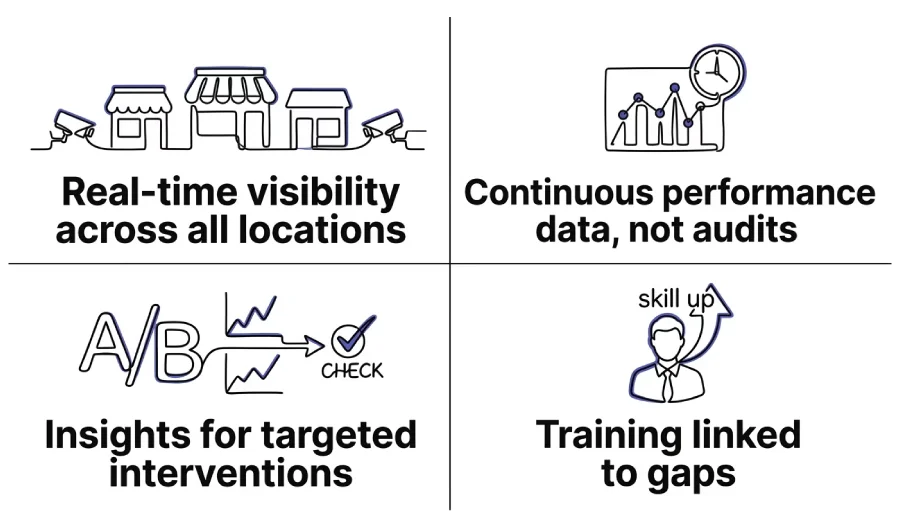
Centralized Operational Visibility
Real-time intelligence platforms monitoring hygiene across the entire
network.
Clear and Practical SOPs
Every successful QSR chain runs on well-defined Standard Operating Procedures. Critically, these SOPs aren’t just written for compliance — they’re
designed to be simple, repeatable, and practical, something teams can actually follow during busy service hours.
What SOPs Cover
- Cleaning frequency & sanitization procedures
- Chemical dilution ratios
- Equipment cleaning protocols
- Food-contact surface sanitation
- Personal hygiene & waste handling
The Real Challenge
Writing procedures is relatively easy. Ensuring they’re followed
consistently — across every shift, every team, every location — is where
the real challenge begins.
Even the best SOPs have limitations without the right monitoring and
reinforcement structures in place.
Daily Hygiene Checklists
To bridge the gap between procedures and execution, most QSR kitchens rely on structured daily hygiene checklists — operational guardrails that
keep hygiene routines embedded in daily workflows.
Checklist Tasks Include
- Sanitizing surfaces & cleaning equipment
- Verifying hand hygiene
- Monitoring food temperatures
- Managing waste disposal
- Checking chemical usage
Why Paper Checklists Fall Short
Incomplete Entries
Late Documentation
No Verification
No Pattern Visibility
That’s why many chains are moving toward digital hygiene tracking
systems.
Multiple Layers of Oversight
Managing hygiene across hundreds of stores requires more than frontline supervision. Most QSR brands operate with a layered oversight model — but
even strong oversight faces one persistent challenge: visibility.
Corporate Quality Teams
Structured audits & network-wide compliance evaluation
Regional Managers
Periodic outlet visits to verify standards are maintained
Store Managers & Shift Supervisors
Daily task completion per SOPs at the frontline
Without centralized monitoring tools, it’s difficult for leadership teams to clearly see what’s happening across every location in real time.
Continuous Workforce Training
At the heart of every kitchen operation are people. No matter how well-designed the
SOPs are, they won’t work if employees aren’t trained properly. Leading QSR brands
invest heavily in continuous training focused on food safety basics, sanitation methods,
cross-contamination prevention, personal hygiene, and safe equipment handling.
The Modern Approach: Instead of treating training as a one-time activity, the
most advanced organizations link training directly to operational
performance. When data shows a recurring hygiene gap, targeted training is
introduced to address it — making learning more relevant and far more
effective.
Centralized Operational Visibility
One of the toughest challenges for large restaurant chains is maintaining visibility across hundreds of kitchens. Traditional methods — periodic
inspections, manual reports, informal feedback — provide some insight but rarely offer a real-time view of network-wide performance.

Store-Level Monitoring
Track hygiene performance at individual outlet level in real time.

Gap Identification
Identify recurring operational gaps before they become compliance
failures.

Cross-Location Benchmarking
Compare performance across locations and track compliance trends by
region.

Audit Documentation
Maintain clear, centralized records ready for regulatory and internal
audits.
Why Inspections Alone Aren't Enough
Inspections still play an important role — but they only provide a snapshot. A typical restaurant kitchen operates 16 hours a day, performing thousands
of hygiene-related actions every week. A short inspection can only observe a tiny fraction of those activities.
Traditional Model
Inspection-driven monitoring
Compliance reporting
Periodic snapshots
Compliance reporting
Periodic snapshots
Modern Intelligence Model
Continuous hygiene visibility
Operational performance insights
Real-time network awareness
Operational performance insights
Real-time network awareness
Modern restaurant networks need something more powerful than occasional audits. They need continuous operational intelligence.
The Role of Digital Hygiene Intelligence Platforms
To support this shift, many food service companies are adopting digital platforms designed specifically for operational hygiene management.
Platforms such as HygieneIQ bring several key functions into a single system.

Structured Assessments
Operational hygiene evaluations built into
daily workflows.

Image-Based Evidence
Visual proof of compliance captured
directly in the field.

AI-Assisted Evaluation
Automated compliance scoring reduces
manual review burden.

Centralized Dashboards
Network-wide hygiene performance visible in one place.

Performance-Linked Training
Targeted learning triggered by real operational data gaps.
Hygiene management shifts from a reactive process — fixing issues after inspections — to a proactive system built around operational intelligence.
Where Restaurant Hygiene Is Heading
As restaurant networks continue expanding, the complexity of managing operations will only increase. Maintaining consistent hygiene standards will
require organizations to move beyond traditional compliance models toward a new discipline.
Hygiene will evolve from a periodic inspection exercise into a continuous operational intelligence discipline.
Consistency Is Built — Not Assumed
Customers rarely see the systems that keep restaurant kitchens safe. But those systems are the reason they trust the brand.
For large QSR chains, food safety isn’t just about passing inspections. It’s about building operational structures that ensure hygiene standards are
maintained across every location, every shift, and every team. Because
Systems
SOPs, checklists, and structured processes
that standardize hygiene practices across the
network.
Visibility
Centralized intelligence platforms that
provide real-time insight into daily hygiene
execution.
Continuous Intelligence
Data-driven training and performance
monitoring that close gaps before they
become failures.
Share:
