

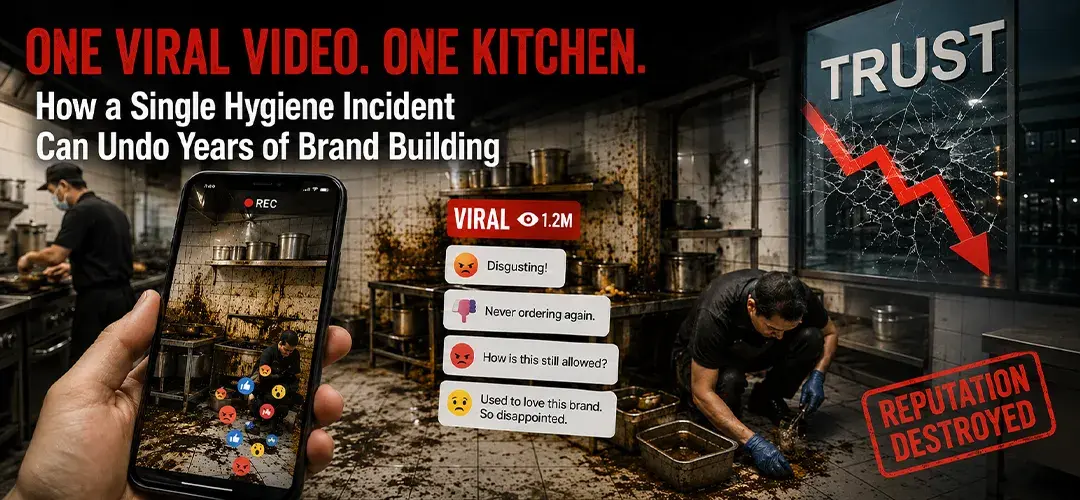
One Viral Video. One Kitchen. How a Single Hygiene Incident Can Undo Years of Brand Building
It took one restaurant brand 15 years to build 200 outlets across India. It took one video, 48 hours, and three million views to put all of it at risk.
The Risk No One Is Prepared For
The Challenge
India’s food service brands have navigated supply chain disruptions,
pandemic closures, inflationary pressures, and intensifying
competition. Most have come through in reasonable shape.
But there is a category of risk that even well-run, well-resourced restaurant brands are not adequately prepared for — and it does not arrive with advance warning.
But there is a category of risk that even well-run, well-resourced restaurant brands are not adequately prepared for — and it does not arrive with advance warning.
Why It Matters
A single food hygiene incident, captured on a mobile phone and posted
to social media, has the capacity to inflict more brand damage than
years of operational underperformance.
Not because the incident is necessarily severe — but because of the speed and reach with which it travels, the way it activates consumer anxiety, and the permanence ofthe record it creates.
Not because the incident is necessarily severe — but because of the speed and reach with which it travels, the way it activates consumer anxiety, and the permanence ofthe record it creates.
From Kitchen to National News in 72 Hours
The mechanics of how a food safety incident becomes a national story in India follow a pattern that, once recognised, is almost entirely predictable.
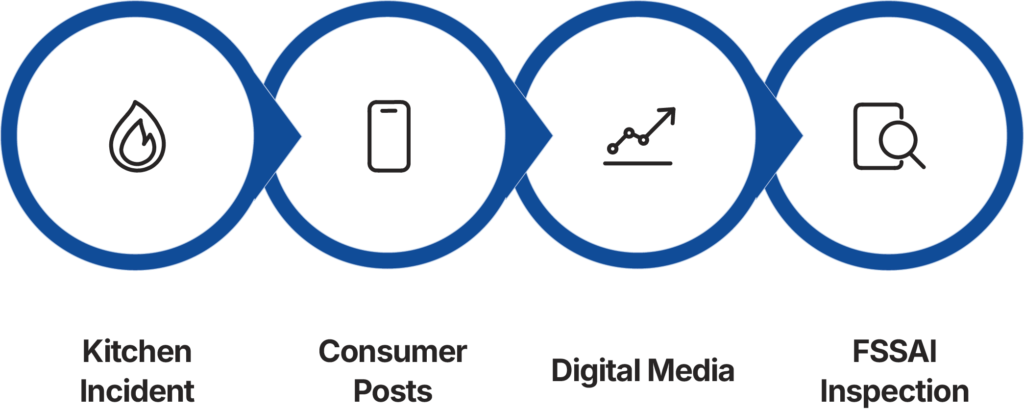
The entire arc — from kitchen incident to regulatory inspection — can now unfold in less than 72 hours. And the brand’s ability to control any part of
that sequence once the content has been posted is extremely limited.
Why India's Social Media Landscape Amplifies the Risk

Near-Zero Friction
In India’s food delivery context, consumers are
already on an app and connected to a reviewing
infrastructure. The gap between experiencing
an incident and reporting it publicly is near-zero.

Highly Shareable Content
Food safety content — particularly visual
content showing kitchen conditions or pest
activity — activates visceral consumer anxiety.
It spreads faster and reaches further than
almost any paid marketing campaign.

Permanent Digital Record
Digital news outlets monitor social media for
trending content. A hygiene incident generating
significant engagement becomes a news story
that is indexed, searchable, and permanent.
What These Incidents Have in Common
It is tempting to treat viral food safety incidents as random or unforeseeable — a case of bad luck, an isolated lapse. The evidence does not support
that framing.
Standard Drift Precedes the Incident
In almost every case, the hygiene failure
that gets filmed was not new — it was
established. The incident created
visibility, not a problem. Pest presence is
a lagging indicator of hygiene breakdowns
developing over weeks or months.
Monitoring Gaps Enable the Drift
The kitchen had not been continuously
monitored. Periodic audits produced
compliance scores that did not reflect the
kitchen’s daily operational reality.
The Brand Had No Early Warning
There was no system to detect
deterioration before it became a public
event. The first signal the brand received
was the viral content itself.
Why Crisis Management Is the Wrong Response
Every time a significant food safety incident goes viral in India, the affected brand deploys the same response: a public apology, temporary closure,
deep cleaning, staff retraining, and a third-party audit.
What Crisis Management Does
These responses can limit short-term damage. But they are damage
control — addressing the symptom, not the cause. Deep cleaning a
kitchen after a viral incident does not fix the hygiene culture or
monitoring gaps that allowed standards to erode.
The Uncomfortable Truth
Brands that rely on crisis management as their primary food safety risk
strategy are, in effect, hoping that the next deterioration cycle will not
result in a visible incident. Sometimes they get lucky. Sometimes they
do not.
The Delivery Platform Dimension
There is a specific dimension of this risk that is particularly acute for restaurant brands operating on Zomato, Swiggy, and other food delivery
platforms — which, in India’s organised food sector, means almost everyone.
0
→ 3.6
Rating Drop
A restaurant dropping from 4.2 to 3.6 stars on a
delivery platform following a hygiene incident
does not recover that lost ground quickly.
↓
Algorithmic Penalty
Lower-rated restaurants receive reduced
platform visibility — compounding the
commercial impact of reputational damage.
0
%
Cloud Kitchen Risk
For cloud kitchens with no physical presence,
platform reputation is the entire business. A
hygiene incident is an existential commercial
risk, not just a PR problem
Building the Only Genuine Protection
If viral hygiene incidents are consistently the visible surface of underlying operational deterioration, then the protection against them is a system that
detects and addresses that deterioration before it becomes visible.
Continuous Monitoring
Not periodic audits — continuous hygiene monitoring that reflects
daily operational reality across all locations.
Operational Intelligence
Identifying deteriorating standards at specific locations before they
become entrenched — not after a public incident.
Targeted Correction
Specific training and corrective action addressing specific gaps in
specific kitchens, not generic refreshers on a calendar schedule.
Documented Evidence
A continuous, timestamped record of hygiene performance that
demonstrates any incident is a deviation from maintained standards
— not a reflection of them
The Brands That Don't Go Viral Aren't Luckier
“The brands that do not experience viral hygiene incidents are not luckier than the ones that do. They are better at seeing what is happening in their
kitchens before it becomes something the public sees first.”
When a brand has continuous, evidenced hygiene monitoring across all locations, slow accumulating deterioration simply cannot develop undetected.
The monitoring catches it. The data triggers a response. The correction happens before anyone gets out a phone.
That documented record also provides the basis for a credible response that goes beyond a PR statement — demonstrating that any incident
represents a deviation from maintained standards, not a reflection of them.
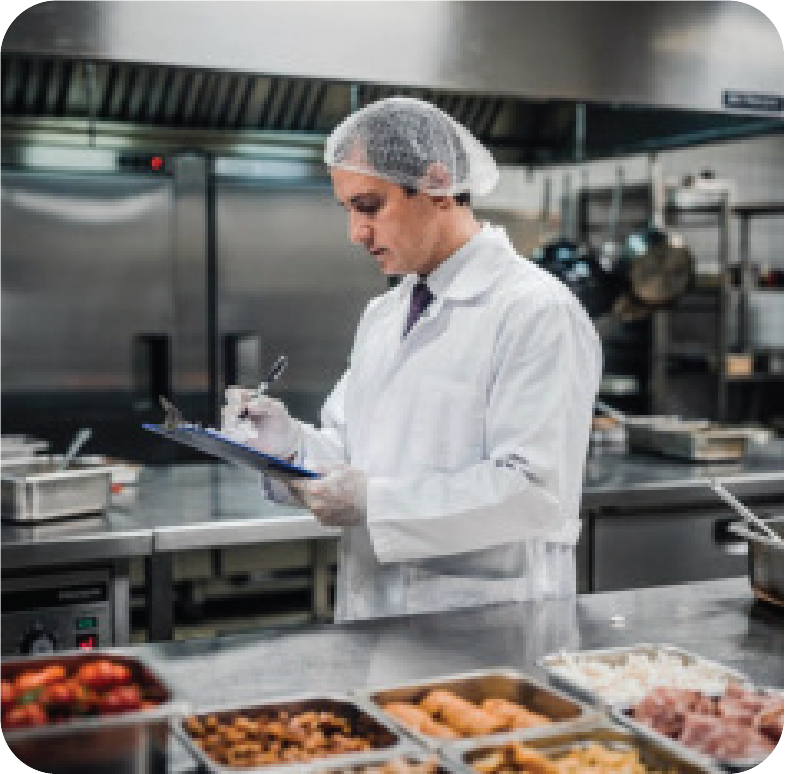
HygieneIQ: Enterprise Food Safety Intelligence
HygieneIQ provides continuous hygiene monitoring and operational intelligence for multi-location food service brands — detecting standard
deterioration before it becomes a public incident, and building the documented evidence of maintained standards that protects brands when things go
wrong.
Continuous Monitoring
Real-time hygiene intelligence
across every location, every day
— not just on audit day.

Operational Intelligence
Early detection of standard drift
with targeted corrective action
before deterioration becomes a
public event.

Documented Evidence
Timestamped, evidenced records
that demonstrate maintained
standards and support credible
crisis response.
Published by HygieneIQ | Enterprise Food Safety Intelligence
Share:
