


The Hidden Cost of High Attrition in Indian Cloud Kitchens — And Why Hygiene Standards Often Pay the Price
India’s cloud kitchen industry has exploded over the past few years. What started as a niche experiment in food delivery has quickly evolved into one of the most dynamic segments of the country’s food service market.
But behind the growth numbers and rapid expansion lies a workforce reality that many operators struggle with quietly: high staff turnover.
And while attrition is often treated as an HR issue, its consequences run much deeper. In cloud kitchens, one of the first areas where the impact shows up — often invisibly — is food hygiene and safety.
A Model Built for Speed and Scale
Cloud kitchens have transformed how restaurants operate in India. The model is compelling: lower capital investment, faster expansion, and the ability to run multiple virtual brands from a single kitchen.
Food delivery platforms like Zomato and Swiggy have accelerated this shift, while rising real estate costs have made traditional dine-in formats harder to scale. For consumers, the appeal is obvious — restaurant-quality food delivered quickly to their homes.
Today, cities such as Bengaluru, Mumbai, Hyderabad, and Delhi-NCR have become major hubs for cloud kitchen activity. Hundreds of operators are competing for visibility and delivery market share.
Yet, beneath this growth story lies a structural vulnerability that rarely receives the attention it deserves: cloud kitchens are especially exposed to workforce attrition, and that turnover has a direct impact on hygiene standards.
The Attrition Reality in Cloud Kitchens
High staff turnover is a long-standing feature of India’s food service industry. But in cloud kitchens, the numbers can be even more extreme.
Industry estimates suggest attrition rates in food service roles often range between 40% and 70% annually. Cloud kitchen environments — where work is fast-paced, repetitive, and tied to demanding delivery timelines — tend to sit at the higher end of that spectrum.
The reasons are largely structural.
Most kitchen staff come from India’s large pool of semi-skilled migrant labour. These workers are highly mobile and often balancing multiple income opportunities. A small difference in pay, better accommodation proximity, or even a shorter commute can easily lead someone to switch jobs.
For operators, this means teams are constantly changing.
A kitchen with 15 employees and a 60% attrition rate will replace roughly nine workers each year. In practice, that means almost the entire team turns over within 18 months.
And every time that happens, operational knowledge walks out the door.
How Attrition Quietly Weakens Hygiene Standards
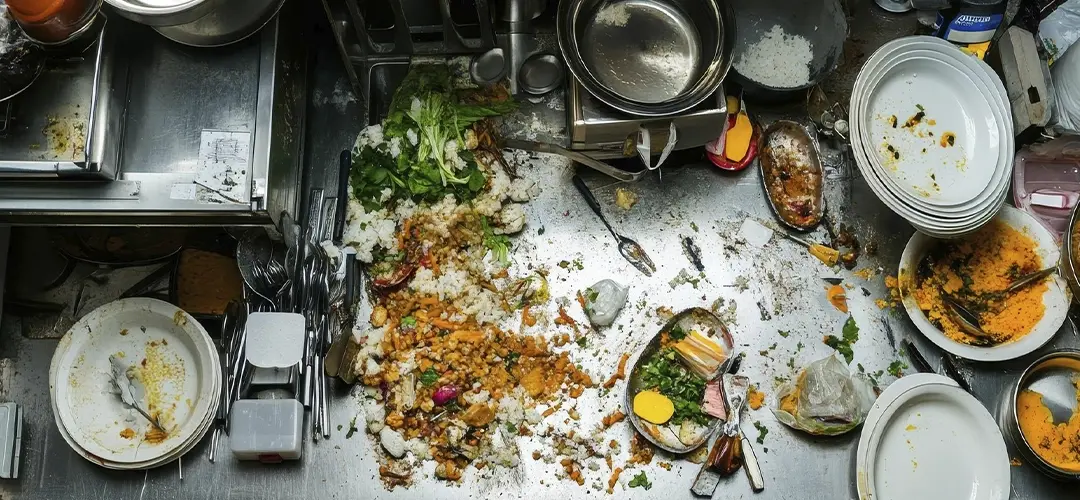
The impact of staff turnover on hygiene rarely appears as a single dramatic incident. Instead, it shows up slowly — through a series of small deviations that gradually weaken operational discipline.
Most cloud kitchens invest time in defining hygiene protocols: cleaning schedules, temperature monitoring procedures, cross-contamination safeguards, and personal hygiene rules.
Experienced staff follow these routines instinctively. They understand not just what needs to be done, but why it matters.
When those employees leave, new hires step in. They may receive a short induction or a quick orientation around the kitchen. But the deeper understanding that comes from weeks or months of experience takes time to build.
In that transition period, small gaps start to appear.
Cleaning still happens, but surfaces may be wiped without proper sanitisation. Temperature logs may be filled in late or from memory instead of being recorded in real time. Staff may be less certain about allergen separation or raw-ingredient handling.
Personal hygiene practices — handwashing, glove use, hair protection — become inconsistent.
Individually, these issues may seem minor. But when several of them occur together, the kitchen’s hygiene discipline begins to erode.
And because the changes happen gradually, they often go unnoticed until a larger issue surfaces.
The Visibility Problem
One of the biggest challenges cloud kitchen operators face is simply knowing what’s happening inside their kitchens every day.
Most organisations rely on a mix of periodic audits, supervisor inspections, and customer feedback from delivery platforms. These are useful signals — but they are also lagging indicators.
An internal audit conducted once a month cannot tell you whether hygiene standards were maintained during the three weeks between visits.
A supervisor’s morning inspection doesn’t capture what happens during the intense 8pm dinner rush, when the kitchen is running at full capacity and half the team may be relatively new.
And by the time delivery ratings start to drop, the underlying operational problem has usually already occurred.
As cloud kitchen networks grow across multiple locations, this visibility gap becomes even more difficult to manage. The more kitchens an operator runs, the harder it becomes to identify where hygiene standards are drifting — and why.
Why More Training Alone Doesn’t Solve the Problem
When operators recognise that hygiene standards are slipping, the typical response is to increase training.
Training is important. But in high-attrition environments, generic training programs rarely deliver lasting results.
Most cloud kitchens rely on scheduled training cycles: an induction for new hires, occasional refresher sessions, and perhaps additional training before an audit.
While well-intentioned, this approach has a fundamental limitation — it treats all kitchens and all problems as if they were the same.
In reality, hygiene challenges vary widely.
One kitchen may struggle with cold-chain discipline. Another may have issues with cleaning procedures. A third may need reinforcement around personal hygiene practices.
Yet all teams often receive the same standard training modules.
In high-turnover environments, where employees may stay only a few months, training must be timely, targeted, and directly linked to real operational gaps.
Otherwise, it quickly loses effectiveness.
A Different Approach: Continuous Hygiene Intelligence
Forward-thinking food service operators are beginning to rethink how hygiene is monitored and managed.
Instead of relying primarily on periodic inspections, many are moving toward a continuous monitoring model — one that creates real-time visibility into how kitchens are actually operating.
At its core, the idea is simple: you cannot manage what you cannot consistently measure.
In practice, this approach includes:
Regular structured hygiene assessments
Centralised visibility across locations
Pattern detection across the network
Training triggered by real data
Instead of generic training schedules, interventions are triggered when specific hygiene gaps appear, ensuring staff receive the most relevant guidance.
This approach doesn’t eliminate workforce attrition — which remains a structural reality in India’s food service sector.
But it does allow operators to detect and correct hygiene risks much faster, before they escalate into regulatory problems or brand damage.
The Extra Complexity of Multi-Brand Kitchens
Many cloud kitchen operators in India run multiple virtual brands from a single facility. In some cases, one kitchen may support five or more delivery brands simultaneously.
While this model improves asset utilisation, it also increases operational complexity.
Different brands may involve different ingredients, preparation methods, or allergen profiles. Staff must switch between these workflows quickly during busy service periods.
Maintaining hygiene discipline in such environments requires even greater operational clarity.
Now layer high staff turnover onto that complexity.
A new employee joining a single-brand kitchen has one set of hygiene procedures to learn. In a multi-brand cloud kitchen, that employee may need to understand several — and apply them correctly while working under intense delivery pressure.
Without strong monitoring and targeted training, the risk of hygiene gaps rises significantly.
Turning a Risk Into an Operational Advantage
India’s cloud kitchen sector will continue expanding rapidly in the coming years. And workforce attrition is unlikely to disappear anytime soon.
Operators who view attrition simply as an unavoidable challenge will continue to face the hygiene risks that come with it.
But operators who invest in systems that detect and respond to hygiene gaps quickly can fundamentally change how those risks are managed.
There is also a competitive advantage here.
Food delivery platforms increasingly highlight hygiene ratings. Consumers are becoming more aware of food safety standards. And a single public incident can damage a brand’s reputation overnight.
In this environment, consistent and demonstrable hygiene performance is becoming more than just a compliance requirement — it is a differentiator.
Operators who build strong operational visibility into their kitchens today will be far better positioned to scale confidently tomorrow.
HygieneIQ helps cloud kitchen operators continuously monitor hygiene performance, detect gaps linked to workforce transitions, and trigger targeted training interventions based on real operational data — creating a system that keeps hygiene standards strong even in high-attrition environments.
