

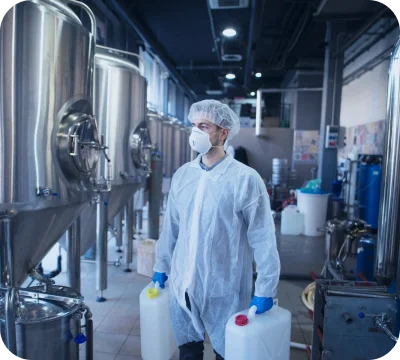
Why Hygiene Training Fails in Most Restaurants
Your kitchens have completed every training module. Induction checklists are
signed off. Refresher sessions have run on schedule. And yet — hygiene gaps
keep showing up. Not because your people don’t know better. Because knowing
better and actually doing it, consistently, under pressure, are two very different
things.
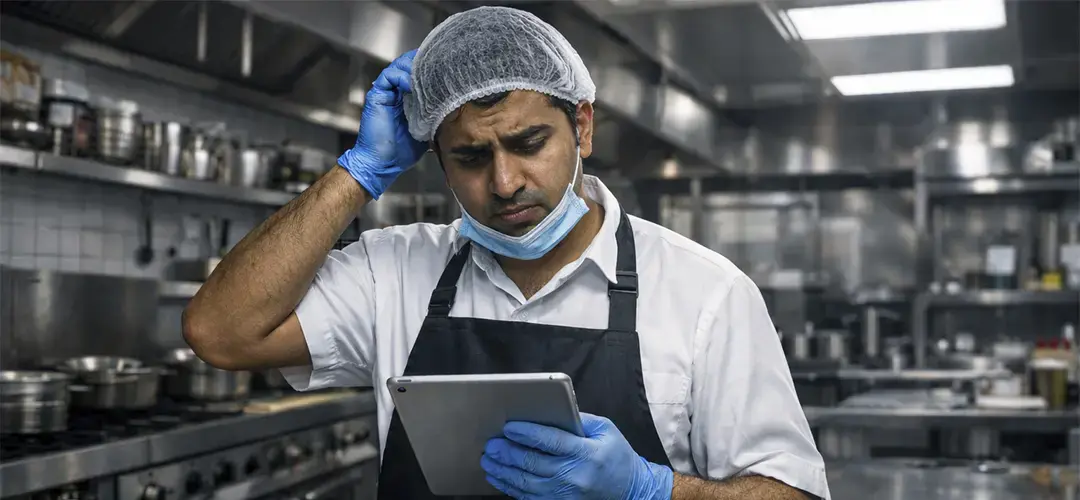
The Gap Between Records and Reality
What the Records Show
- SOP manuals on shelves
- Signed induction checklists
- LMS completion rates in the green
- Refresher sessions logged on schedule
What the Kitchen Shows
Go into the kitchen on a Friday evening. 200 covers coming through.
Two prep cooks called in sick. A new delivery driver near the pass.
The dishwasher running behind. Watch whether every handwashing step is followed every single time. Watch whether the cleaner who joined last week is executing protocols under that kind of pressure.
The dishwasher running behind. Watch whether every handwashing step is followed every single time. Watch whether the cleaner who joined last week is executing protocols under that kind of pressure.
That gap — between what training records say and what the kitchen is actually doing — is one of the most stubborn and expensive
problems in food service.
Knowing the Right Thing and Doing It Are Not the Same
Most hygiene training is built on a simple assumption: teach staff what to do, and they will do it. Decades of research in behavioural science
and food safety have shown this assumption to be wrong. Knowledge helps — but it is nowhere near sufficient.
Operational Pressure Overrides Training
When a kitchen is slammed, shortcuts happen not because
people don’t care — but because the brain prioritises getting
food out over 40 backed-up tickets.
Training Environment ≠ Work Environment
Hygiene training happens in a quiet break room. Kitchens are
noisy, physical, and high-pressure. Human behaviour is context-
dependent — transfer of habits is genuinely hard.
What Is Not Reinforced Gets Forgotten Fast
Without consistent reinforcement, a significant portion of what
someone learns fades within days. A day-one induction has
limited staying power by end of week four.
Generic Training Feels Irrelevant
Abstract food safety modules disconnected from a person’s real
job are less likely to be internalised — and even less likely to be
applied when things get busy.
High Turnover Turns Training Into a Treadmill
In India’s restaurant sector, kitchen attrition typically runs between
40% and 70% annually. A kitchen with 12 staff and 60% attrition is
onboarding seven or eight new people every year — each needing to
learn SOPs, understand protocols, and reach consistent execution,
all while adjusting to a new workplace.
Training gets squeezed into gaps between service. New joiners are put on the line before consolidating anything. Supervisors — the most important reinforcement mechanism — are too stretched to provide consistent coaching.
The result: a kitchen almost always running with a portion of its team in the early, fragile period of habit formation — when deviation risk is highest.
Training gets squeezed into gaps between service. New joiners are put on the line before consolidating anything. Supervisors — the most important reinforcement mechanism — are too stretched to provide consistent coaching.
The result: a kitchen almost always running with a portion of its team in the early, fragile period of habit formation — when deviation risk is highest.
40 -
%
Annual Kitchen Attrition
Typical range across India’s restaurant sector
7 -
New Hires Per Year
In a 12-person kitchen at 60% attrition
There is also a quieter loss: experienced staff carry the informal
culture of a kitchen — the habits, norms, and unspoken
expectations that shape how a team actually behaves. When they
leave, that culture erodes.
Training Without Reinforcement Is Just a Box-Tick
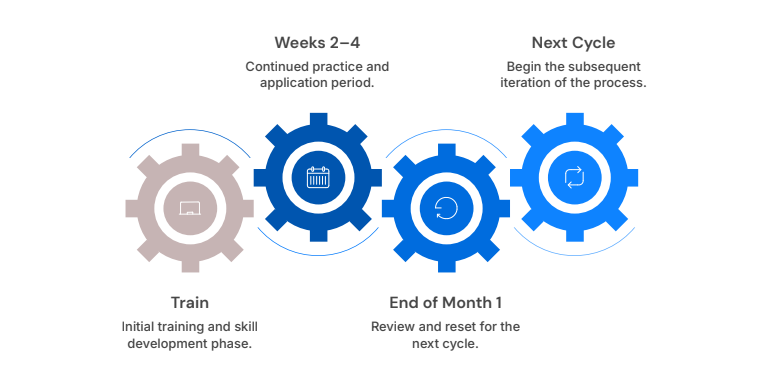
A single training event cannot produce lasting behaviour change. In most restaurant kitchens, the reinforcement infrastructure after training
ends is thin to the point of being almost nonexistent.
Significant time and money goes into training programmes that produce temporary compliance peaks rather than lasting change. The
calendar keeps running. The failures keep happening. Train. Brief improvement. Slow reversion. Repeat.
The Same Training, Sent to Very Different Problems
Most restaurant chains run standardised hygiene training — same content, same format, same schedule — rolled out uniformly across every
location. It makes administrative sense. But hygiene failures are not standardised. They are specific.
Kitchen in Chennai
Persistent cold chain problem — refrigeration units not cleaned
properly, temperatures not logged consistently. Gets a personal
hygiene session instead.
Kitchen in Pune
Poor allergen separation in prep and inconsistent personal hygiene
in the morning team. Gets a refresher on temperature monitoring
instead.
Standardised training addresses the average hygiene challenge — not the real one. In a chain where every kitchen has its own
patterns of failure, training that cannot account for specificity will always leave significant gaps unaddressed.
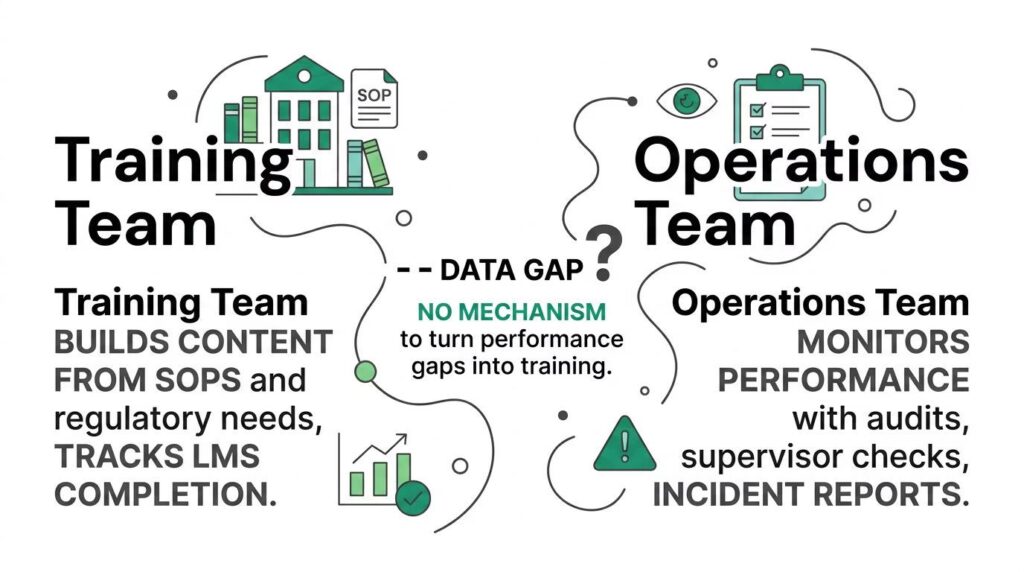
Training and Operations Are in Different Rooms
If you look at the pattern across all these problems — the behaviour gap, the attrition treadmill, the lack of reinforcement, the standardisation
issue — they all share one root cause. Training and operational performance data do not talk to each other. Fixing this is not a content
problem or a delivery problem. It is a structural one.
What Performance-Linked Training Actually Looks Like
Performance-linked training flips the question: instead of asking “what does the training calendar say?”, it asks “what is the operational data
telling us about where hygiene is breaking down?”
Continuous Operational Monitoring
Structured assessments across all
kitchen locations — run regularly, not just
during formal audits — capturing hygiene
execution against defined parameters,
backed by image evidence.

Turning Data Into a Diagnostic
Identify which specific hygiene
parameters are failing most consistently,
at which location, in which shift or team.
Pattern recognition turns a compliance
record into a genuine training diagnostic.

Training Triggered by the Gap, Not the Calendar
A kitchen failing on surface sanitation
gets targeted reinforcement on cleaning
protocols. A location with sliding cold
chain compliance gets focused retraining
on temperature management — because
there is a real, current, identified need.
Measurement shifts too: not whether the module was completed — but whether hygiene performance in that specific area actually
improved. If temperature log compliance moves from 55% to 82% after targeted training, that is a real result.
Reinforcement, Turnover Resilience & the Supervisory Advantage
Real-Time Reinforcement
When assessments happen regularly and results are visible to
supervisors in near real time, supervisors can step in before drift
becomes a habit — before a customer complaint, before a full
retraining programme is needed.
Scaled across dozens or hundreds of kitchens, this creates a system of continuous micro-corrections — small adjustments made early — rather than waiting for problems to accumulate and fixing them in bulk.
Scaled across dozens or hundreds of kitchens, this creates a system of continuous micro-corrections — small adjustments made early — rather than waiting for problems to accumulate and fixing them in bulk.
Built to Survive High Attrition
When monitoring is continuous, new joiners cannot quietly slide
into non-compliant habits. Gaps get caught during exactly the
window when the most important behavioural patterns are being
formed.
When training is triggered by specific operational gaps, what a new joiner learns is directly relevant to their real kitchen — making a significant difference to retention and application.
When hygiene performance is visible at every level — from kitchen supervisor to operations head — accountability lives in the system, not in which individuals happen to be in the building that week.
When training is triggered by specific operational gaps, what a new joiner learns is directly relevant to their real kitchen — making a significant difference to retention and application.
When hygiene performance is visible at every level — from kitchen supervisor to operations head — accountability lives in the system, not in which individuals happen to be in the building that week.
Training Is the Tool. Behaviour Is the Point.
The food service organisations that build the strongest hygiene cultures are not necessarily the ones running the most training. They are
the ones most serious about whether that training is actually producing lasting changes in how their kitchens operate.
Training completion is an input. What a line cook does at 8pm on a busy Saturday — when no one is watching and the tickets are backed up — is the output. Closing that gap requires continuous monitoring, honest gap identification, targeted interventions, and reinforcement that makes hygiene accountability part of every shift — not just a scheduled event.
HygieneIQ connects operational hygiene monitoring directly to workforce training — so training is triggered by real kitchen performance data, not a fixed calendar. When a compliance gap is identified at a specific location, the right training goes to the right team. And as performance improves, the data shows it.
Training completion is an input. What a line cook does at 8pm on a busy Saturday — when no one is watching and the tickets are backed up — is the output. Closing that gap requires continuous monitoring, honest gap identification, targeted interventions, and reinforcement that makes hygiene accountability part of every shift — not just a scheduled event.
HygieneIQ connects operational hygiene monitoring directly to workforce training — so training is triggered by real kitchen performance data, not a fixed calendar. When a compliance gap is identified at a specific location, the right training goes to the right team. And as performance improves, the data shows it.
Share:
