

Why Periodic Hygiene Audits Fail Modern Restaurant Chains
A kitchen that runs for 16 hours a day can’t realistically be evaluated by a quarterly
inspection. Yet for many restaurant chains in India, that’s still the primary way food
safety standards are checked.
How the Traditional Audit Model Works
The Familiar Routine
An auditor arrives, inspects the kitchen, reviews hygiene practices,
checks documentation, and scores the outlet against a checklist. A
report is generated, corrective actions are listed — then everyone
waits for the next audit cycle.
Why It's Breaking Down
For a long time, this approach worked reasonably well — restaurant
chains were smaller and easier to oversee. But today’s networks are
larger, faster, and far more complex. QSR brands are scaling across
multiple cities, cloud kitchens are expanding rapidly, and operational
pressure is higher than ever. In that environment, the traditional audit
model begins to show serious cracks.
The Snapshot Problem
An audit only shows you what’s happening at that exact moment — how the kitchen looked on the morning the auditor was present. It doesn’t
reveal what happened last week, what will happen tomorrow, or how consistently hygiene procedures are followed the rest of the quarter.
In most operational quality systems, that would be considered an extremely weak sample. In food safety — where consequences can involve customer illness, regulatory action, or brand damage — it becomes even more problematic.
In most operational quality systems, that would be considered an extremely weak sample. In food safety — where consequences can involve customer illness, regulatory action, or brand damage — it becomes even more problematic.
hrs
Daily Kitchen Operation
Typical operating window for a restaurant
kitchen
0 .
%
Audit Coverage
Share of quarterly operating time observed
during a 3–4 hour audit
99 .
%
Unseen Activity
Operational time where hygiene practices go
unobserved
The Audit Preparation Effect
Anyone who has worked in restaurant operations knows what usually happens
when an audit is coming. A few days beforehand, the kitchen gets extra attention
— equipment is deep-cleaned, teams are reminded of SOPs, temperature logs are
checked, and supervisors ensure everything looks exactly as it should.
Peak Performance Window
The auditor sees the kitchen at its absolute best — a brief moment that may
not reflect day-to-day operational reality.
Gradual Return to Baseline
Performance improves just before the inspection, then gradually returns to its
normal standard afterward.
The Uncomfortable Truth
The report on file may not represent the conditions under which customers
are actually being served most of the time.
The Challenge Multiplies Across Locations
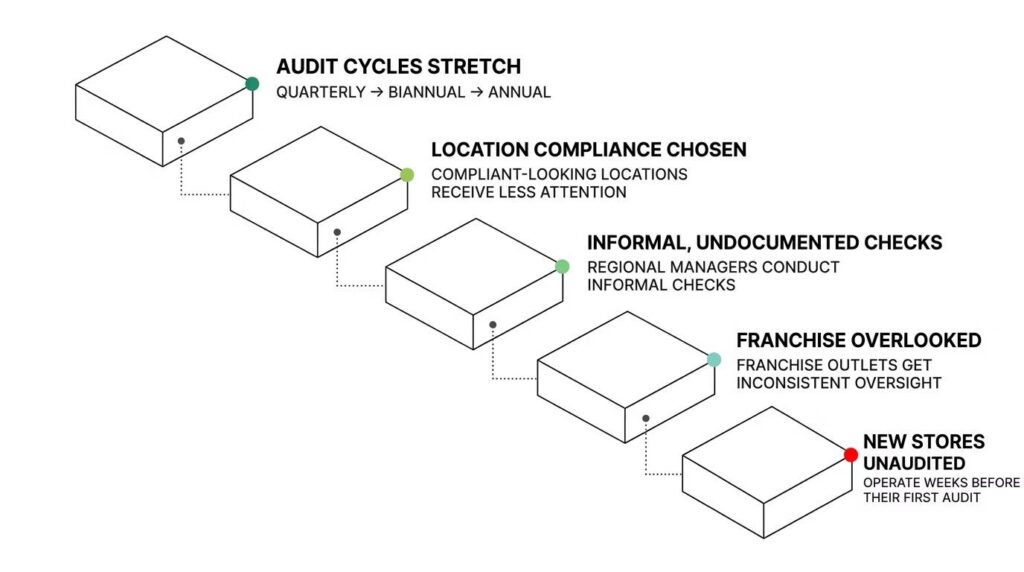
These limitations become even more significant when a restaurant brand operates dozens or hundreds of outlets. A QSR chain with 150
locations audited quarterly would need to conduct 600 audits every year — a massive logistical task most growing brands can’t sustain.
On paper, the organisation still has a compliance program. In practice, the coverage may be far less effective than it appears.
Where Hygiene Standards Actually Live
Food safety in a restaurant kitchen isn’t determined during an audit. It’s determined by hundreds of small decisions made every day — during
busy shifts, when staff are under pressure, and when teams with different training levels are working together.
These everyday actions are what truly determine hygiene performance — and by definition, they happen when no auditor is present.
These everyday actions are what truly determine hygiene performance — and by definition, they happen when no auditor is present.
Hand Hygiene
Does a staff member wash their hands properly every time they
should?
Temperature Logs
Are refrigerator temperatures checked in real time — or logged later
from memory?
Cross-Contamination
Are cross-contamination rules followed during the dinner rush?
Cleaning Completion
Are cleaning steps completed fully, or shortened when the kitchen
gets busy?
The Stakes Have Changed
The limitations of periodic audits have always existed. What’s changed is the environment restaurants operate in today. Three major shifts
have raised the stakes dramatically.
Social Media Visibility
A single hygiene incident can spread
online within hours. What once might
have been a local issue can quickly
become a national story.
Stronger Regulatory Oversight
Food safety enforcement in India is
becoming more dynamic. Inspections can
now be triggered by complaints or online
reports rather than predictable
schedules.
More Aware Consumers
Customers today care more about
hygiene than ever before. Reviews,
ratings, and brand perception are heavily
influenced by how safe a restaurant
appears.
Relying on a system that observes less than 1% of operational activity is not a strong risk management strategy in today’s
environment.
Why Digital Checklists Don 't Fully Solve the Problem
Many restaurant brands have tried to modernise their audits by switching
from paper checklists to digital inspection tools. This definitely improves
administration — reports are faster, records are easier to store, and data is
easier to share.
But it doesn’t solve the core issue. A digital audit conducted every three months is still just a snapshot. Even if the report is perfectly documented, it still leaves most operational activity unseen.
Digital checklists rarely provide deeper insight — identifying recurring hygiene patterns, comparing locations, or predicting which kitchens might be heading toward compliance issues. They make the audit easier to manage, but they don’t fundamentally change how hygiene performance is understood.
But it doesn’t solve the core issue. A digital audit conducted every three months is still just a snapshot. Even if the report is perfectly documented, it still leaves most operational activity unseen.
Digital checklists rarely provide deeper insight — identifying recurring hygiene patterns, comparing locations, or predicting which kitchens might be heading toward compliance issues. They make the audit easier to manage, but they don’t fundamentally change how hygiene performance is understood.
What's Still Missing
- Recurring hygiene pattern detection
- Cross-location performance comparison
- Predictive compliance risk signals
- Continuous operational visibility
- Targeted, gap-based training
What Modern Restaurant Chains Actually Need
The real solution isn’t simply improving the audit — it’s changing the model entirely. Instead of asking “How do we audit our kitchens four
times a year?” modern organisations are asking: “How do we understand what’s happening in our kitchens every single day?”
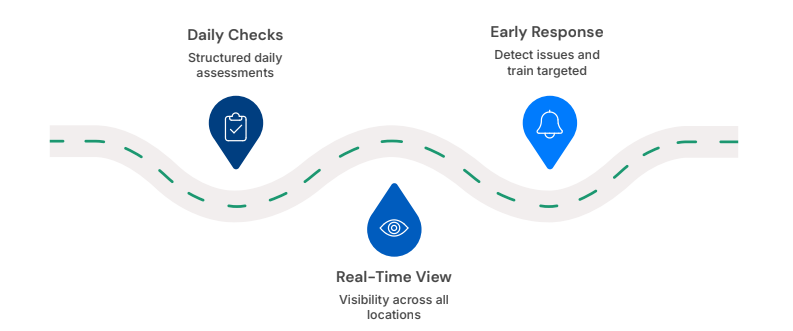
In this model, hygiene assessments happen regularly through structured workflows, operational data creates a continuous performance history, and training is targeted based on actual gaps — not generic schedules. Audits don’t disappear; they become a validation layer that confirms standards the organisation already understands.
In this model, hygiene assessments happen regularly through structured workflows, operational data creates a continuous performance history, and training is targeted based on actual gaps — not generic schedules. Audits don’t disappear; they become a validation layer that confirms standards the organisation already understands.
A Simple Question Every Restaurant Leader Should Ask
What’s actually happening in your kitchens on the days when no auditor is there?
If the honest answer is “we’re not completely sure,” the issue isn’t just auditing capacity — it’s the model itself. Today’s restaurant chains face rapid expansion, high staff turnover, public scrutiny, and stronger food safety enforcement. That gap can only be solved by creating continuous visibility into daily operations.
If the honest answer is “we’re not completely sure,” the issue isn’t just auditing capacity — it’s the model itself. Today’s restaurant chains face rapid expansion, high staff turnover, public scrutiny, and stronger food safety enforcement. That gap can only be solved by creating continuous visibility into daily operations.
HygieneIQ is a continuous hygiene intelligence platform built for multi-location food service organisations in India. It enables real-
time monitoring across kitchens, identifies recurring operational gaps, and links compliance data with targeted workforce training —
ensuring every outlet operates at the same standard, every day.
Share:
